The return of race politics
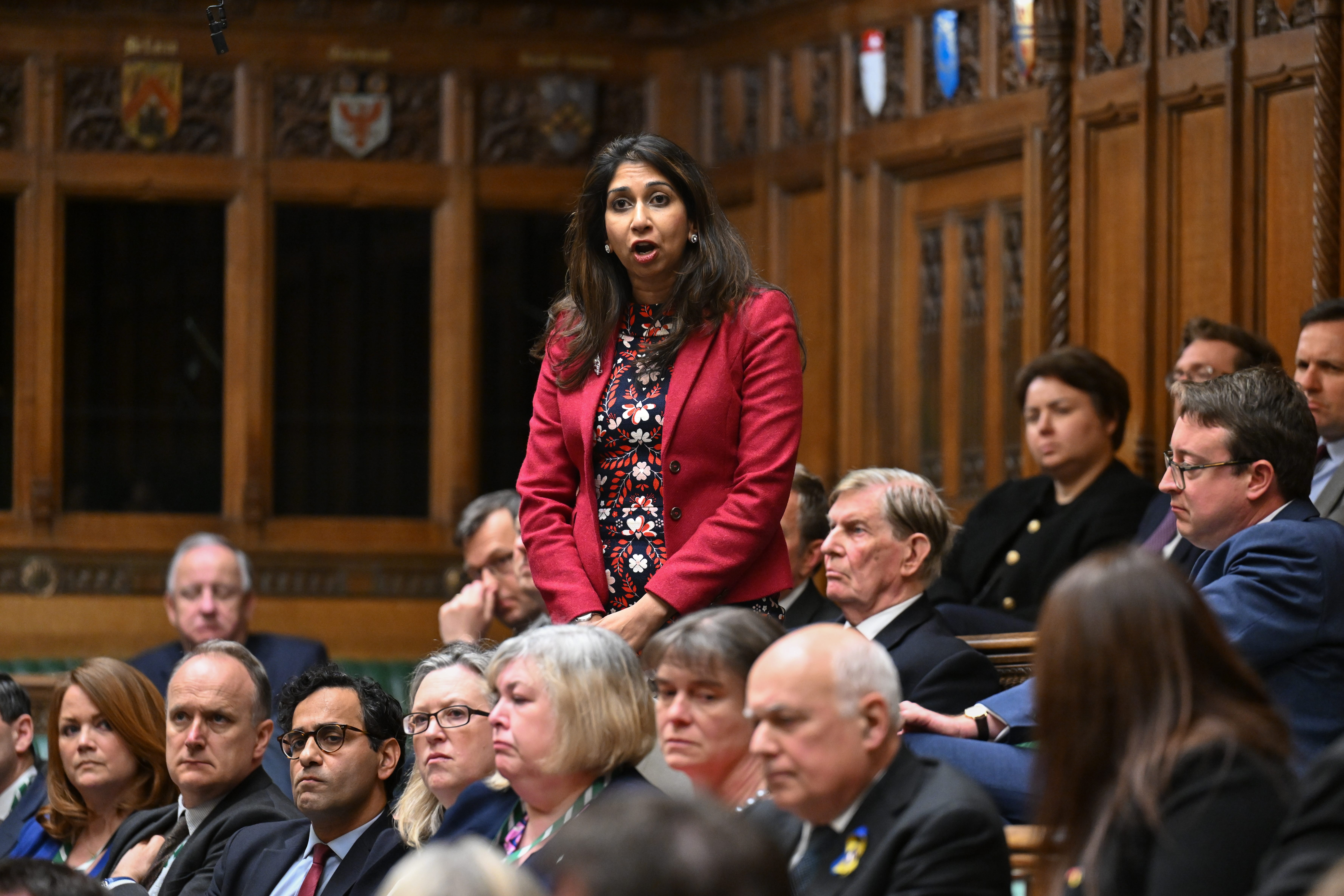
I pity Suella Braverman. Once upon a time I merely disliked her, but we’re well past that now. Today, I just feel this sense of sorrow for her. I’m not sure I have ever seen someone debase themselves to this extent in the name of ideology.
This week, Braverman - who was born in Harrow, educated at Cambridge, and lives in Hampshire - took to the internet once again to insist that she is not English - ostensibly because of her ancestry, but in reality because of her race. It’s like watching a wounded animal feast on its own intestines, a grotesque parable about confusing short term and long term incentives.
Over just two years, race has returned to British political debate, in a way that has not happened since Enoch Powell’s Rivers of Blood speech. We see the poison everywhere - on the streets, on the English Channel. But we also see it in the hideous contortions it is imposing on right-wing ethnic minority politicians. It is mangling their identity out of all recognition.
Something very strange and disturbing is happening in this country, of which Braverman is just the most pitiful example.
When Rishi Sunak became prime minister, his ethnicity was barely mentioned. Unlike Barack Obama’s arrival in the White House, say, the emergence of the UK’s first ethnic minority prime minister was met with complete indifference.
“Whatever issues people had with me as PM - and there was no shortage of those - neither my race nor my religion was among them,” Sunak wrote recently in the Sunday Times. “I was often struck by how foreign leaders would assume these things must have been major symbolic moments. Yet for the vast majority of Brits they just weren’t that big a deal.”
In so far as race was mentioned in this period, it tended to be by the left rather than the right. On the left, there was an army of hyper-online campaigners for racial justice, who would quickly highlight any failure to abide by their progressive standards. On the right, debate was almost completely deracialised. Brexit, for instance, was the great conservative victory of the last ten years. It was reactionary, sentimental, anti-immigrant, jingoistic, occasionally xenophobic, obnoxious and deeply, deeply stupid. But it wasn’t racist. Great care was taken by anti-immigrant politicians to make sure they never crossed that line.
The reason they took great care was because a firm enforcement arrangement was in place. There were strong social norms against racism. And there was an army of eager progressive types who really, really wanted to call conservatives racists. Was it great? No. Online progressives were very annoying in the early 2020s. But at least they were motivated by decent ideals and it worked to keep racism in check.
This relatively benign state of affairs continued until the second Trump administration, at which point all hell broke loose.
When Trump returned to the White House, two things happened simultaneously. The first was that things could be said which previously would never have been said. The Trump victory was seen as a comprehensive triumph over the forces of woke in every country. It was as if he had won an election for world president. Why? Why did Trump’s political victory in the US expand into a cultural victory across the Western world?
The reason was not strictly electoral. It was about social class. Many commentators - from prominent social media accounts to newspaper columnists to radio presenters - saw an opportunity. Until Trump’s return, they had been under threat of social ostracisation and abuse for being insufficiently careful in their use of language. Perhaps they said Latino instead of Latinx, or failed to ask someone’s pronouns. Whatever. Everyone in this period was trying not to be the main character on Twitter on any given day.
For a prominent commentator, this posed a not-insubstantial threat to their career. Certainly, it constituted the political issue which most affected them on a day-to-day basis. It was far more pertinent to them than ICE immigration raids or abortion. So they jumped eagerly on the new cultural moment. And they did this not really as political supporters of Trump’s overall agenda, but as representatives of their social class, as commentators.
The second thing that happened was that more extreme content was now purposefully spread on X, under Elon Musk, whereas centrist or liberal content was downgraded. Many progressive commentators emphasised this trend by leaving X, but most mainstream political reporters stayed on. This therefore created a two-fold dynamic. The incentives against using racial language collapsed and the incentives to use racial language increased. In many cases, that incentive was flatly financial. Rupert Lowe, for instance, is said to have earned £105,000 from his rants on X.
The outcome was depressingly predictable. In February 2025, Triggernometry podcast co-host Konstantin Kisin started asking questions about Sunak which had not been raised when he was prime minister. “He’s a brown Hindu,” Kisin said. “How is he English?” He later denied this, and then confirmed it, and has basically been a bit all over the place on it, but the basic fact is that he said it and it authorised plenty of other people on the right to start voicing their opinions on whether people of other races or religions can be English. Right-wing thought has now radicalised to such an extent that the question ‘can a brown man be English’ was this week the hottest subject of debate.
Sunak’s response, which he clearly hates having to articulate, has been very good. He correctly spotted that this test was much more primitive and restrictive than that which was applied by the most extreme figures of his childhood. When he was growing up, there was the Tebbit test, basing identity on which cricket team you supported. “For all the criticism it received,” Sunak said, “this was a test that anyone could pass. If you supported England because you now saw it as home, you were part of the team regardless of the colour of your skin. Ten-year-old me passed the test without even knowing about it.”
This is way too kind. Most Asians I know support England in the football but revert to the team of their heritage in the cricket - the choice of cricket specifically is designed to make it very difficult for people to belong. But whatever - Sunak’s fundamental point is that you can at least choose to satisfy that test. Kisin’s test is far harsher. “In this world, if you’re not white it doesn’t matter who you support at the cricket: you can never be English. This reverse Tebbit test is impossible for any non-white person to pass.”
Once this debate emerged, Braverman was presumably caught between her desire to secure attention and her own identity. She chose the former and denied her own Englishness.
This week she was at it again. “As I’ve said before, I’m not English,” she said. “I’m proud to be British. My family and ancestors have a link to Britain which spans centuries. But in no way are we English. Yes, I was born in England, speak English and support the England football team. And indeed, I love England and the English people. But to say I’m English is to take a ‘laissez-faire, anything-goes’ attitude to ethnicity, citizenship and identity. It also denies me my Asian heritage.”
It’s rare to watch so many things die at once: logic, dignity, self-regard. Her mind is a death cult, a collective suicide pact against cognition.
I don’t want to break this down too much, because to do so gives her too much credit. This is fundamentally a psychological issue not a political one - she is intriguing as a pathological case study, but not as a meaningful set of intellectual propositions.
That being said, you simply cannot follow the sentence ‘in no way are we English’ with ‘I was born in England, speak English and support the England football team’. I mean, no matter how restrictive a view you have of national identity, being born in a country, speaking its language and supporting its sports teams has to have some impact. And of course Braverman is very English. You can tell by her accent, her manner and her concerns. I wish she weren’t. I despise the kind of Englishness she represents - small-minded, thin-skinned and jealous. But she is clearly the product of it.
Similarly, you cannot hold these views and support the England football team, because most of that team are, according to those views, not English. In fact, if you follow Braverman’s system the whole national story starts to dissolve. Off the top of my head, we lose Disraeli, Churchill, Eliot, Dahl, Mercury, the King. Obviously our origin as a nation collapses, with each wave of Romans, Angles, Saxons, Danes and Normans contradicting her muddled criteria. Our political leadership falls away, our literature dissolves, our music ceases, the royal family falls, the whole bundle of political, social and cultural English contributions unravels.
Zia Yusef, Braverman’s unhinged Reform colleague, evidently feels the same way as her. When Sagal Abdi-Wali, a former child refugee and leader of Camden Council, was made Labour candidate in the upcoming Holborn and St Pancras byelection, he wrote: “The front runner being foisted on the people of Holborn by Labour to replace the former prime minister Keir Starmer in our parliament was born in Somalia. Do you understand what’s happening?”
Abdi-Wali’s story is a profoundly beautiful one of someone arriving here in the 90s with no English and now running one of the largest councils in the country, on the verge of entering parliament. Only a truly shattered personality would think this ugly.
I don’t know what goes on in the screaming, bloodied corridors of Yusef’s mind. But it is extraordinary that he thinks he can attack a Muslim from Somalia without undermining his own position in our society. He, unlike Abdi-Wali, was born here, to Muslim parents from Sri Lanka. But does he truly believe that the type of people targeted by this message will appreciate the difference between these two positions? Does he really think he can stoke hatred against Muslims who came here as children without stoking hatred against Muslims who were born here? What an irresponsible naive chump.
At this point, you could see the cogs start to turn in the brains of even the dumbest right-wing politician. Laila Cunningham, Reform’s candidate for mayor of London, has all the intellectual heft of a puddle in the autumn. But she is the daughter of Egyptian immigrants and she could tell what dangers lay in wait if this type of logic were followed to its conclusion. “I don’t know what he meant by that comment,” she told the Standard. “I read it a few times.”
Obviously she does, she just doesn’t like the implications. But that at least displays a greater capacity for self-awareness than Yusef himself possesses.
As Jacob Ress-Mogg said this week: “I’m very surprised at Zia Yusef, who I would have thought would want to be English. If he doesn’t want to be English, why would he want to govern this country?”
This is the situation among ethnic minority politicians on the right. But there are signs that this corrosion of our standards is seeping into the Labour party leadership too. It has turned progressive language for racial justice into a mutilated, debased, unholy parody of itself.
In April, home secretary Shabana Mahmood was doing an event with podcast host Matt Forde when a man in the audience accused her of “out-Reforming Reform”. She told him to fuck off.
What came out of her mouth next was a kind of word salad which proved very difficult to understand. Criticism of her immigration policy, she said, was “a way of delegitimising the perfectly valid, legitimate views of millions of people in this country, including ethnic minorities in this country… You’re trying to put me in a box, which includes a lot of people who think I don’t even belong in my own country. That’s why I said this individual can just fuck right off, because I know I belong in my own country. You’re not going to be able to do that to me.”
What in God’s name does this mean? It’s very hard to parse. Things become clearer when we listen to what she said last November in the House of Commons, when Lib Dem home affairs spokesperson Max Wilkinson said she was “stoking division by using immoderate language” on immigration.
“I wish I had the privilege of walking around this country and not seeing the division the issue of migration and asylum system is causing in this country,” she replied. “Unlike him, unfortunately I am the one who is regularly called a [P-word] and told to go back home…. I do not think it is acceptable or appropriate for people in this place to not acknowledge the real experience of those who sit outside of this House.”
Suddenly Mahmood’s view becomes much clearer. She has taken the language of online progressives from the early 2020s and twisted it to suit her purpose. It’s all there - the idea that white people do not recognise their ‘privilege’, the notion that brown and black people have ‘real experience’ of racial issues which gives them epistemological priority over white people. But here they are both being co-opted for a right-wing anti-immigrant agenda and weaponised against progressives.
Mahmood’s argument is that racists must be given exactly what they want because it’s the only way they’ll stop being racist to her. It seems much more likely that they will continue to be racist given that she is explicitly saying it helps trigger political change in their preferred direction. The idea that outright racists who shout slurs at brown people in the street can be placated by lowering the number of small boat arrivals this quarter is absurd. It’s also a fundamental misunderstanding of what racism is. It is not a rational retail-politics response to new arrivals. It is hateful obscurantist poison.
But the practical implications of Mahmood’s position are even more alarming. Her response to Wilkinson indicates that white people are not entitled to question her on it. She has created a racial test by which her position cannot be challenged. She is dividing critics by race and giving them different rights to question her policy. At the top of the Labour party, a horribly mangled form of racial politics is beginning to emerge.
The return of race to British political debate is a disaster, a regression into the ugliest aspects of our past. It is the moral equivalent of someone forgetting how to walk. Across the right, you can see it doing something poisonous and terrible, something truly frightening, providing a kind of class leadership to the balaclava-wearing thugs on the street.
This piece is about the way that ethnic minority politicians have responded to this moment. Some of them, like Sunak, have adopted precisely the right approach: principled, cautious, moderate, intelligent, insightful. Others, like Braverman and Yusef, have given us a demonstration in self-hatred and deep-seated psychological collapse. And others still, like Mahmood, have demonstrated how cynically the return of racial politics can be used to counter those who oppose it.
I write this to take stock, really. I want something to demonstrate where we got to, after just two years of a return to race politics. I want to record how quickly we are slipping into the worst of what we once were, into the gutter viciousness and paranoia of race politics. You can see it contorting everything. But there is probably no more disturbing thing to witness than what it has done to the minds of ethnic minority politicians on the right.
Odds and sods
You can listen to this newsletter as a podcast at the top of the page or on Spotify. You can follow me on BlueSky, Instagram or TikTok.
This week’s column for the i paper was on Andy Burnham’s meeting with Donald Trump, which was covered in the most baffling way. Read it here. There was an extra addition of the newsletter on Tuesday on Ed Davey’s conference speech. Read it here.
This week’s Origin Story was on John Rawls, the great liberal political philosopher of the post-war period. One of the hardest things about being progressive is knowing the limit to inequality. For communists, it’s easy. There’ll be no inequality. For neoliberals, it’s also easy. There’s no limit to inequality. But most people live somewhere between these positions, never sure where to draw the line. We accept that you need inequality to encourage invention and productivity, but we know there’s something deeply wrong with a world where people scrape by on shit contracts while tech billionaires earn more than many countries. Rawls is the guy who shows you how to draw the line: a systematic account of why inequality exists and what its limit should be. It’s through understanding him that you finally get to clarify your own instincts on how the world should work. Listen to it wherever you get your podcasts.
I read Heat Wave by Penelope Lively, a dense, introspective, unsentimental novel about a mother watching her daughter make the same mistakes in her marriage that she made in her own. It’s sun kissed and pleasant, but you spend your entire time within the mind of a woman suffering wordlessly, claustrophobic. I particularly enjoyed the way that no actual conflict takes place. Hell, they barely even speak. Instead, the daughter will occasionally glean what her mother is thinking and change behaviour without anything being said. Profound moments of solidarity, empathy and alienation all take place wordlessly, in glances and micro-movements. It is very, very English and therefore a suitable choice for this particular edition of the newsletter.
Right now fuck off you cunts.
Striking 13 is free, for everyone, forever. If you can afford it, become a paid subscriber to keep it free for those who cannot.
Comments (0)
No comments yet.