How Facebook built the Death Star

Hello and welcome to another Striking 13 guest post, this time by Andrew Hunter Murray. Andrew is one of those insultingly talented people who manages to succeed at various different activities at the same time.
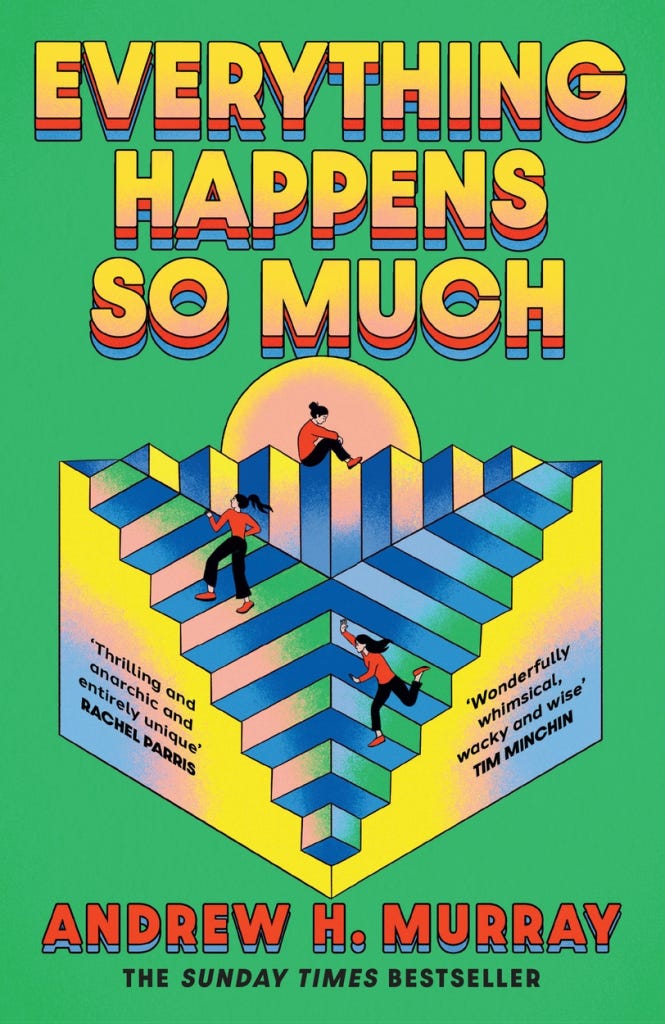
He was a writer and researcher for the BBC panel show QI, co-hosts the spin-off podcast series No Such Thing as a Fish, works as a writer for Private Eye and hosts the magazine’s podcast, Page 94. He also writes fiction and has just published ‘Everything Happens So Much’. In my blurb on the back I said it was: “Wry, giddy, explosive, and deeply humane: Catch-22 for the Instagram generation”.
It’s really good. Really annoyingly good.
He is also younger than me. I hate him. Anyway, here’s a piece by him deploying a metaphor he has extended to within an inch of its life in order to talk about the subtle harm of social media.
Thanks to Ian for hosting this. In a lapse from his usual excellent standards, I’m afraid I don’t call anyone a c*** in it – well, not explicitly, anyway. It’s about how the last 21 years have changed us utterly, without most of us taking more than cursory interest. And because I’m a colossal nerd it starts off with something from Star Wars…
This is how to build the Death Star.
And it’s the story of how I – and, probably, you – spent the last 21 years building it together, without either of us realising what we were doing.
For anyone reading this who isn’t a colossal geek, a) what are you doing on Ian’s Substack, this is supposed to be a safe space, and b) don’t worry, it’s not really about the Death Star.
A few rules of thumb as you begin:
Do not, under any circumstances, tell people they’re building the Death Star. People rarely sign up to construct the Death Star. ‘Is that a good thing?’ they will ask, when you approach and inform them the Death Star is recruiting in their area. They will hesitate. They’d rather be having fun with their friends. So, to that end:
Tell people they are having fun with their friends. A Death Star is many things – a civilisation-wrecking ultimate weapon, for one, capable of leaving whole worlds nothing more than smouldering rubble – but from the perspective of its architects it is simply a titanic infrastructure project, and if modern Britain has taught us anything about infrastructure projects, it’s that you’re likelier to get it over the line if you secure buy-in (yuck) from your (yuck) key stakeholders. So for heaven’s sake make sure people think they’re having a good time.
If you can’t make it fun, make it addictive. If you can make a game out of building the Death Star, if you can make people think they need to be building the Death Star, if you can ensure that whenever they are awake people’s fingers twitch with the effort of not picking up their device and checking how well they have done on the Death Star today, you are far likelier to succeed. Ensure the motivations of your workforce are in the right place, and your gigantic laser is already half-finished.
When all else fails, tell people it’s meaningful. If you can sell people on the idea that the Death Star is actually not a civilisation-wrecker but in fact a way of enhancing the connections between all of us on this beautiful earth and for their one beautiful life, they’ll go along with it even harder. Even when they start thinking they are not having fun, and that in fact they rather preferred life before the Death Star, they’ll be much less likely to put up a fight.
Make sure not even the makers call it by its true name. The top people involved must have no clue what they are building. They must have the ability to hide even from themselves, from their most secret hearts, what they’re doing. In truth, they probably started out not even wanting to build the Death Star, but that’s what they’ve got, and they’re sure as hell not going to shut it down simply because of how it turned out. Have you seen how much work went into this thing? And if we shut it down, someone else would only build another and take all our custom. No thank you.
I was 18 when it arrived in Britain. It was my first week of university, and it was the newest and most exciting game in town. I signed up, and so did all my new friends, whole battalions of us hopping up together onto the trucks to the factory. We were first on board and now, half my lifetime later, the billions of us around the world who did the work can finally step back, and assess what we built, and whether it turned out to be the fun and wonderful thing we were promised.
Other people have written of their own experiences at Death Star Incorporated. Some were much higher up in the organisation, and their stories are well worth reading. But I think it’s also worth noting the perspective of a humble foot soldier. Most of us, after all, were exactly that.
Nor is this the story of the other stuff the D.S. did: the great wrongs of action and omission committed along the way. A civil war here, a compromised election there. That’s for the historians. This little contribution of mine is simply about how the Death Star got into all of our heads, and what it did to us along the way.
Alright, let’s drop the cute analogy. (I can’t face writing the words ‘Death Star’ any more.) 21 years ago, when I was just 18, I got to university, the very week that Facebook announced it was opening up shop in the UK. It had been trading in America for a year already, and now it was coming over here. The Columban Exchange was about to go into reverse.
It is hard to overemphasise how primitive the world of then looks to anyone today. If you wanted to speak to someone, you could give them a call, or text them, and desperately hope they would text back. You couldn’t find them via their handle, because nobody had a handle. If you asked someone ‘What’s your @?’ they would look at you like you’d grown horns. If you wanted to upload your shonky photos of your wonderful, pre-social-media nights out onto your computer – all flash and red eyes – it was a bit of a pain. (All the above will seem totally normal to anyone over 40 and completely insane to anyone under 30. That should be a warning sign.)
We didn’t realise it, of course. We were quite certain we were modern people. After all, the Iron Age students only a few years before us had genuinely communicated by stuffing notes into each other’s pigeonholes. Not us. We’d been on messageboards, things like MySpace and MSN Messenger. Many of us no longer even needed to go to Snappy Snaps, for Christ’s sake. We were technologically advanced.
Spoiler: we were not. It was 1492, and we were watching the rather large sails approaching over the horizon, and faintly wondering if the people on those ships might affect our way of life.
On this side of the Atlantic, only students at a few universities were allowed to sign up. In fact, you needed an official email address from those few universities to be allowed to join. It was restricted, and therefore elite. Another thing that was hard to remember now: it was for young people to connect with each other. That was the point. If you had joined and found your elderly aunt there, or even worse, a politician, it wouldn’t have been cool or fun or edgy. No, it started for the young, just like the young people who’d founded it.
The guy who’d set it up was clearly a massive nerd, but he was only a few years older than us, so he must be broadly on our side. And apparently he’d set up the precursor site to rate other students’ attractiveness, but that was what nerds did, wasn’t it? It wasn’t like he was powerful.
So we walked in. And when we did… what was there for us to do? A profile page. A wall other people could write on, and their walls for you to write on. Rather endearingly, there was space for your ‘favourite quotes’. There was your ‘relationship status’ – the thrill of seeing that someone you fancied had gone from ‘in a relationship’ to ‘it’s complicated’. There were private messages, if you had something to say that couldn’t be sprayed onto their wall. And there was your status. ‘Andy Murray is…’ and then a blank space, waiting for you to fill it with a joke, or a boast, or something sincere.
Your ‘favourite quotes’ will still be there, incidentally, under ‘details about you’. These days they’ve become a little time capsule, buried by all the slurry on your newsfeed. Mine include lines from Addams Family Values (I stand by that), jokes from friends I haven’t seen in two decades, and also for some reason, a Lebanese proverb: “He who has money can eat sherbet in hell.” Well, the people behind Facebook – who are, of course, also the people behind Instagram, and WhatsApp, and Threads, and those glasses for creeps – will have plenty of sherbet in the next life, wherever they end up.
We loved it, of course. My university social life ran on it. Some people had impossibly large numbers of friends; some people had very few, but almost nobody had declined to sign up. The recruitment campaign was extraordinarily successful.
And now – twenty years on, twenty extraordinary and exhausting years where so many of our old certainties have been flipped and distorted – what was the effect?
We’ve all grown up a lot, for one. These days, literally the last people who don’t seem to have twigged that social media posts can come back to bite you are Reform UK councillors. In the Zuckercene era, Reform UK councillors are the equivalent of the uncontacted groups on the Andaman Islands who fire arrows at anyone who approaches (apologies to the Andaman Islanders for this gross slur on them).
But there has been a much bigger effect, one that has dogged me for years, and one that feels so flinchingly personal I hardly like to mention it now, even though it’s the heart of this essay.
Here it is: when you give people frictionless access to each other’s lives, but only to heavily edited and partial versions of each other’s lives, you are creating a psychological dirty bomb. The truth is that almost all our lives are mundane, almost all the time. But by giving people these extraordinary shears where they can snip out the best bits of their best days, and present them to the world as their everyday, you are taking the natural grass-is-greener of human existence and fitting it with rocket boosters.
It’s not anyone’s fault that they do this. It is entirely natural. I work on radio shows and podcasts, and I write articles and books, and when you do that, you quickly learn that a good edit is the razor-thin, all-important difference between the amateurs and the pros. The edit is the difference between a boring, jumbled, two-hour podcast recording that will not earn you new listeners, and a crisp snappy 45-minute episode that your audience will love.
As with podcasts, so with life.
I spent almost all of my twenties worrying I was doing life wrong. When I met a friend, I would come away from the conversation convinced they had the answer – no matter what path they’d chosen – and that I had chosen badly. Maybe, I would say as I came away from seeing a friend who was becoming a teacher, or a doctor, or whatever, maybe there’s time for me to change. Maybe there’s time for me to pick the right path. I can turn this around, and stop feeling like this all the time.
I’m not going all class-action-lawsuit about this. Some of the above feeling is simply the vulnerability of being young. And after all, I signed up freely. It just so happens that I then spent years admiring other people’s lives and thinking I’d done something terribly wrong by failing to have the kind of life I was seeing online.
I know the problem boils down to nothing more complicated than this: ‘the real world and the online world are not the same; they are only fleetingly, tangentially related.’ I know the truth of that with every cell of my brain. And yet it has taken me twenty years and I still haven’t fully learned it in my heart. The ancient human urge to compare ourselves with others – once harmlessly focused on your wife’s sister’s husband and whether he had a newer Ford Fiesta than you – has transformed into a permanent neverending carousel of uranium-tipped insecurity. It doesn’t matter if you have a million followers: someone else out there will have two million, and you, by comparison, must therefore be a no-good dumbo nothing.
Eventually, I managed to get my head together, and have written a story about the problem. Because I am incapable of doing anything seriously, it’s about a world where you can take a pill and get 15 minutes in an alternate version of your own life. And it’s about a woman in that world who has spent so long looking at her unlived lives that she has forgotten to live her own. Her name is Esme. I thought of the name first, then realised after writing about her for two years that ‘Esme’ sounds almost exactly like ‘It’s me’. D’oh.
There are resistance movements, of course. As I write this, the Guardian is covering the ‘Ceilidh renaissance’ luring young people offline “in search of real-life joy”. I hope these rebels succeed – my God, I hope they do – but they have a slight feeling about them of an attempt to escape the screens by going backwards. To return to Star Wars for a moment, we are still searching in vain for the convenient exhaust ports which will allow us, at the very last moment possible, to blow the fucker up.
It still hangs in the sky over all of us. We are still building it, myself included. I joined Instagram in 2025, for Christ’s sake, the equivalent of arriving at a party three days after the last plastic cup has been binned.
But I know the vents are there somewhere. I feel confident we’ll find them. The vents have to be there.
Unless, of course, the vents are inside our own brain, and these people have simply found a way of using our own personalities against us.
That, I concede, might be a harder one to solve.
Everything Happens So Much is now available to order at Waterstones and other good bookshops.
Comments (0)
No comments yet.