Reading Isn’t Over Yet
The Age of Reading Is Over
In the August issue, Rose Horowitch considered whether civilization can survive our postliterate era.
Rose Horowitch’s “The Age of Reading Is Over” is devastating. The comparison between our present moment and the long, undramatic decline of the Library of Alexandria is apt: We are witnessing a gradual failure of will and attention.
I am a conductor, and I was struck by the parallel with musical literacy. A score, like a serious book, demands an ability to hold a complex structure in your mind and resist the urge to skim. When that capacity atrophies, music becomes background, atmosphere, content. The difference between reading Doctor Zhivago and reading a romantasy novel is not unlike the difference between listening to a late Beethoven quartet and letting a playlist wash over you.
David Woodard
Tampere, Finland
While I appreciate Rose Horowitch’s deep dive into the decline of literacy, I take issue with conflating concern about reading in general with concern about the specific kinds of literature people are reading. Though well-meaning, the story was full of judgmental rhetoric about graphic novels, audiobooks, and works of fiction with shorter and simpler sentences. One series I love, “The Empyrean,” was among those ridiculed in the article.
Years ago, I absorbed such judgments subconsciously, and it caused me to take a decade-long break from reading. I started reading for pleasure again only when I gave myself permission to ignore what I thought I “should” read. I’m a Millennial mom of three kids, ages 10, 7, and 3. I take them to the library weekly and read to them every day. Raising them, I’ve learned to resist the urge to judge books as the “right kind” or “wrong kind.” Regardless of what they’re reading, my kids are using their imaginations, learning new concepts, exploring new perspectives, and strengthening their attention spans. Most important, they’re learning to follow their innate curiosity, laying the groundwork for a lifelong love of reading.
Faigy Gilder
Fair Lawn, N.J.
One detail in Rose Horowitch’s article made me chuckle. Harvard’s assistant director for humanities and social-sciences support tells her about a student who “was struggling to read a book written in Old English”: Anthony Burgess’s 1962 novel A Clockwork Orange. That novel, however, is narrated in an invented futuristic slang that draws on Russian words. A sentence on page 1 begins: “Our pockets were full of deng, so there was no real need from the point of view of crasting any more pretty polly to tolchock some old veck in an alley.” It’s worrisome that Harvard students now find books hard to read, but, in their defense, some books actually are.
Lawrence Levi
Brooklyn, N.Y.
Rose Horowitch’s assessment of the decline of reading reminded me of a passage in “The Prelude,” by William Wordsworth. In it, the narrator dreams of a Bedouin frantically riding across the desert on his dromedary ahead of a rising deluge that will drown the world. He carries a stone and a shell—the stone represents knowledge (symbolizing Euclid’s Elements), and the shell, imagination. The rider searches for a place to bury them so they are not lost forever in the flood.
It feels like a perfect analogue for our moment. Those of us who understand the importance of the long sentence are clutching our books and pens as we race ahead of what can seem like a drowning of critical thinking and the academy itself. I am not optimistic that we will find a safe place to hide them all before generative AI washes across the sands.
Art Casale
Kernersville, N.C.
Rose Horowitch’s “The Age of Reading Is Over” is a fascinating and disturbing account of the decline of sustained reading. But I wonder whether “postliterate” is the right description of where humanity is going.
The philosopher Ernst Cassirer called us animal symbolicum—the symbol-using animal. Long before widespread literacy, human beings communicated complex ideas through speech, gestures, pictures, music, numbers, and other symbols. Alphabetic writing was an extraordinary development in that history, but need not be our final form of communication.
Horowitch rightly distinguishes reading words from the higher-order abilities of comprehension and synthesis. But must those abilities always depend on long-form prose? A composer can communicate through musical notation. A mathematician can compress an elaborate argument into a handful of symbols. And we communicate more and more through combinations of words, diagrams, photographs, and videos.
I recently gave a group of Japanese business executives a 5,000-word English-language article for discussion. Rather than spend our meeting reading it, I used AI to reduce its argument to 16 slides. We absorbed the argument in about 15 minutes and spent the remaining time doing something distinctly human: questioning it and debating one another.
Perhaps, then, we are witnessing not the death of literacy but another stage in the evolution of symbolic communication. The question is whether Homo literatus can give way to Homo symbolicum without losing the habits of thought that reading taught us.
Dan Considine
Tokyo, Japan
The love of reading, even the necessity of reading, was a gift from my mother. She was a child of Depression-era deep poverty in East Texas, and for lack of clothes, adequate food, and family support, her education ended after eighth grade, despite her having been the spelling-bee champ that year. Yet somehow, she kept her love of reading alive.
Years later, she was a stay-at-home mom raising three daughters on my father’s wages as a heavy-equipment operator—enough for food, basic clothing, and a roof over our heads, but not much more. Still, every few weeks, she would scrape together the taxi fare to take us to the library in downtown Garland, Texas.
For me, that library was a secret door to another world. I was still in elementary school, but wandered the history section, reading about World War II and the Holocaust, and struggling through the novels of Thomas Hardy. Heady stuff.
At home, we had few books, but we did have a blue-bound set of the Britannica Junior Encyclopedia. My mother had bought it from a door-to-door salesman on a monthly payment plan, with little prospect that the payments would ever be made. I kept those books through moves from Texas to Michigan, back to Texas, and finally to California.
Barbara Jean Calfee
Larkspur, Calif.
My name is Aviya, and I am 9 years old. My grandparents subscribe to The Atlantic, and just a few minutes ago, I finished “The Age of Reading Is Over.” It was so interesting, but it also made me angry that there is a need to write about this topic! I wanted to let you know: There is still hope. My friends and I are avid readers and writers. Not to speak too soon, but my teachers still encourage us to read whole books.
I have read many classic works of literature, such as the Little House series, by Laura Ingalls Wilder, and Anne of Green Gables, by Lucy Maud Montgomery, and I plan to start The Hobbit, by J. R. R. Tolkien, very soon. I am not getting my own cellphone until eighth grade. I love to write and draw, and many people I know do too. And I don’t know about you, but I’m pretty sure I still have plenty of white matter in my brain!
Aviya Perlman
Cresskill, N.J.
Rose Horowitch replies:
I’m aware of the irony of publishing almost 9,000 words about how little we read, so I’m grateful to everyone who took the time to get through the story and reflect on it.
Many of your letters point to a tension that runs through the article. The arrival of our postliterate age is not due to any one person’s actions. I, too, often read short, simple works; listen to podcasts; and go days without opening a book. The broader cultural shift we’re seeing has emerged from millions of us making these same choices, day in and day out.
Yet the stories shared by Aviya Perlman and Barbara Jean Calfee show the enduring effects of an individual’s love of reading and learning—and how that commitment can lead to a powerful resurgence of the practice in others.
Behind the Cover
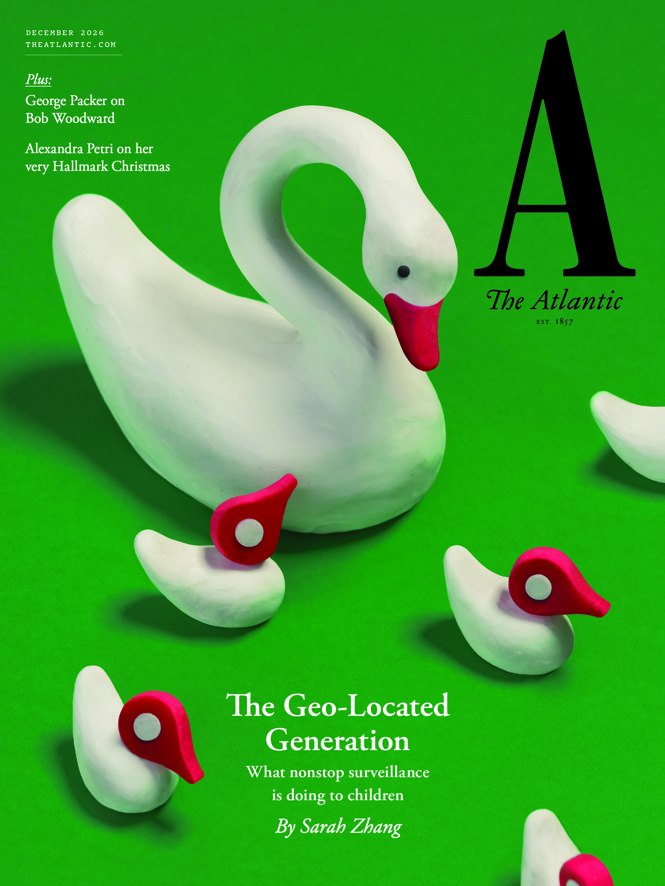
In this month’s cover story, “The Geo-Located Generation,” Sarah Zhang explores how technologies that allow parents to track their children’s whereabouts have changed parenthood and childhood alike. These tools promise to assuage parents’ fears, Zhang writes, but they often generate new anxieties—and curtail the independence that young people once took for granted. For our cover image, the illustrator Miguel Porlan took a familiar image of parental care, a swan looking after a brood of cygnets, and gave it a modern twist.
—Liz Hart, Art Director
Correction
“The Babies Left Behind in America” (November) misstated the name of Eber’s caregiver. Her name is Estela Díaz, not Estela Garcia.
This article appears in the December 2026 print edition with the headline “The Commons.”
Comments (0)
No comments yet.